PDF Index
| SDT-base
Contents
Functions
PDF Index |
Finite element models of structures need to have many degrees of freedom to represent the geometrical detail of complex structures. For models of structural dynamics, one is however interested in
These restrictions on the expected predictions allow the creation of low order models that accurately represent the dynamics of the full order model in all the considered loading/parameter conditions.
Model reduction notions are key to many SDT functions of all areas: to motivate residual terms in pole residue models (id_rc, id_nor), to allow fine control of model order (nor2ss, nor2xf), to create normal models of structural dynamics from large order models (fe2ss, fe_reduc), for test measurement expansion to the full set of DOFs (fe_exp), for substructuring using superelements (fesuper, fe_coor), for parameterized problems including finite element model updating (upcom).
Model reduction procedures are discrete versions of Ritz/Galerkin analyzes: they seek solutions in the subspace generated by a reduction matrix T. Assuming {q} = [T] {qR}, the second order finite element model (5.1) is projected as follows
| (6.92) |
Modal analysis, model reduction, component mode synthesis, and related methods all deal with an appropriate selection of singular projection bases ([T]N × NR with NR ≪ N). This section summarizes the theory behind these methods with references to other works that give more details.
The solutions provided by SDT making two further assumptions which are not hard limitations but allow more consistent treatments while covering all but the most exotic problems. The projection is chosen to preserve reciprocity (left multiplication by TT and not another matrix). The projection bases are assumed to be real.
An accurate model is defined by the fact that the input/output relation is preserved for a given frequency and parameter range
| (6.93) |
Traditional modal analysis, combines normal modes and static responses. Component mode synthesis methods extend the selection of boundary conditions used to compute the normal modes. The SDT further extends the use of reduction bases to parameterized problems.
A key property for model reduction methods is that the input/output behavior of a model only depends on the vector space generated by the projection matrix T. Thus  implies that
| (6.94) |
This equivalence property is central to the flexibility provided by the SDT in CMS applications (it allows the decoupling of the reduction and coupled prediction phases) and modeshape expansion methods (it allows the definition of a static/dynamic expansion on sensors that do not correspond to DOFs).
Normal modes are defined by the eigenvalue problem
| (6.95) |
based on inertia properties (represented by the positive definite mass matrix M) and underlying elastic properties (represented by a positive semi-definite stiffness K). The matrices being positive there are N independent eigenvectors {φj} (forming a matrix noted [φ]) and eigenvalues ωj2 (forming a diagonal matrix noted [\ ωj2 \ ]).
As solutions of the eigenvalue problem (6.95), the full set of
N normal modes verify two orthogonality conditions with respect
to the mass and the stiffness
| (6.96) |
where µ is a diagonal matrix of modal masses (which are quantities depending uniquely on the way the eigenvectors φ are scaled).
In the SDT, the normal modeshapes are assumed to be mass normalized so that [µ]= [I] (implying [φ]T [M] [φ]=[I] and [φ]T [K] [φ] = [\ ωj2 \ ]). The mass normalization of modeshapes is independent from a particular choice of sensors or actuators.
Another traditional normalization is to set a particular component of  to 1. Using an output shape matrix this is equivalent to
  (the observed motion at sensor cl is unity).
  , the modeshape with a component scaled to 1, is related to the mass normalized modeshape by
  .
.
| (6.97) |
is called the modal or generalized mass at sensor cl. A large modal mass denotes small output. For rigid body translation modes and translation sensors, the modal mass corresponds to the mass of the structure. If a diagonal matrix of generalized masses mu is provided and ModeIn is such that the output cl is scaled to 1, the mass normalized modeshapes will be obtained by
ModeNorm = ModeIn * diag(diag(mu).^(-1/2));
Modal stiffnesses are are equal to
| (6.98) |
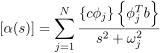
The use of mass-normalized modes, simplifies the normal mode form (identity mass matrix) and allows the direct comparison of the contributions of different modes at similar sensors. From the orthogonality conditions, one can show that, for an undamped model and mass normalized modes, the dynamic response is described by a sum of modal contributions
| (6.99) |
which correspond to pairs of complex conjugate poles λj=± iωj.
In practice, only the first few low frequency modes are determined, the series in (6.99) is truncated, and a correction for the truncated terms is introduced (see section 6.2.3).
Note that the concept of effective mass [44], used for rigid base excitation tests, is very similar to the notion of generalized mass.
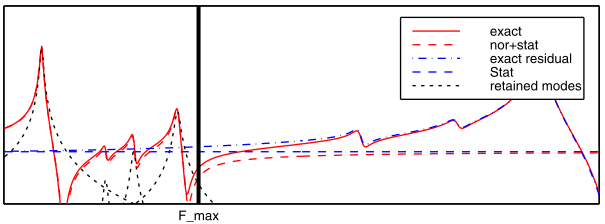
Normal modes are computed to obtain the spectral decomposition (6.99). In practice, one distinguishes modes that have a resonance in the model bandwidth and need to be kept and higher frequency modes for which one assumes ω ≪ ωj. This assumption leads to
| (6.100) |
For the example treated in the demo_fe script, the figure shows that the exact response can be decomposed into retained modal contributions and an exact residual. In the selected frequency range, the exact residual is very well approximated by a constant often called the static correction.
The use of this constant is essential in identification phases and it corresponds to the E term in the pole/residue models used by id_rc (see under res ).
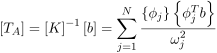
For applications in reduction of finite element models, a little more work is typically done. From the orthogonality conditions (6.96), one can easily show that for a structure with no rigid body modes (modes with ωj=0)
| (6.101) |
The static responses K−1b are called attachment modes in Component Mode Synthesis applications [45]. The inputs [b] then correspond to unit loads at all interface nodes of a coupled problem.
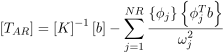
One has historically often considered residual attachment modes defined by
| (6.102) |
where NR is the number of normal modes retained in the reduced model.
The vector spaces spanned by [φ1 … φNR TA] and [φ1 … φNR TAR] are clearly the same, so that reduced models obtained with either are dynamically equivalent. For use in the SDT, you are encouraged to find a basis of the vector space that diagonalizes the mass and stiffness matrices (normal mode form which can be easily obtained with fe_norm).
Reduction on modeshapes is sometimes called the mode displacement method, while the addition of the static correction leads to the mode acceleration method.
When reducing on these bases, the selection of retained normal modes guarantees model validity over the desired frequency band, while adding the static responses guarantees validity for the spatial content of the considered inputs. The reduction is only valid for this restricted spatial/spectral content but very accurate for solicitation that verify these restrictions.
Defining the bandwidth of interest is a standard difficulty with no definite answer. The standard, but conservative, criterion (attributed to Rubin) is to keep modes with frequencies below 1.5 times the highest input frequency of interest.
For a system with NB rigid body modes kept in the model, [K] is singular. Two methods are typically considered to overcome this limitation.
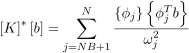
The approach traditionally found in the literature is to compute the static response of all flexible modes. For NB rigid body modes, this is given by
| (6.103) |
This corresponds to the definition of attachment modes for free floating structures [45]. The flexible response of the structure can actually be computed as a static problem with an iso-static constraint imposed on the structure (use the fe_reduc flex solution and refer to [46] or [47] for more details).
The approach preferred in the SDT is to use a mass-shifted stiffness leading to the definition of shifted attachment modes as
| (6.104) |
While these responses don't exactly span the same subspace as static corrections, they can be computed using the mass-shifted stiffness used for eigenvalue computations. For small mass-shifts (a fraction of the lowest flexible frequency) and when modes are kept too, they are a very accurate replacement for attachment modes. It is the opinion of the author that the additional computational effort linked to the determination of true attachment modes is not mandated and shifted attachment modes are used in the SDT.
For coupled problems linked to model substructuring, it is traditional to state the problem in terms of imposed displacements rather than loads.
Assuming that the imposed displacements correspond to DOFs, one seeks solutions of problems of the form
| (6.105) |
where < > denotes a given quantity (the displacement qI are given and the reaction forces RI computed). The exact response to an imposed harmonic displacement qI(s) is given by
| (6.106) |
The first level of approximation is to use a quasistatic evaluation of this response (evaluate at s=0, that is use Z(0)=K). Model reduction on this basis is known as static or Guyan condensation [30].
This reduction does not fulfill the requirement of validity over a given frequency range. Craig and Bampton [48] thus complemented the static reduction basis by fixed interface modes : normal modes of the structure with the imposed boundary condition qI=0. These modes correspond to singularities ZCC so their inclusion in the reduction basis allows a direct control of the range over which the reduced model gives a good approximation of the dynamic response.
The Craig-Bampton reduction basis takes the special form
| (6.107) |
where the fact that the additional fixed interface modes have zero components on the interface DOFs is very useful to allow direct coupling of various component models. fe_reduc provides a solver that directly computes the Craig-Bampton reduction basis.
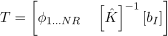
A major reason of the popularity of the Craig-Bampton reduction basis is the fact that the interface DOFs qI appear explicitly in the generalized DOF vector qR. This is actually a very poor reason that has strangely rarely been challenged. Since the equivalence property tells that the predictions of a reduced model only depend on the projection subspace, it is possible to select the reduction basis and the generalized DOFs independently. The desired generalized DOFs can always be characterized by an observation matrix cI. As long as [cI][T] is not rank deficient, it is thus possible to determine a basis  of the subspace spanned by T such that
| (6.108) |
The fe_coor function builds such bases, and thus let you use arbitrary reduction bases (loaded interface modes rather than fixed interface modes in particular) while preserving the main interest of the Craig-Bampton reduction basis for coupled system predictions (see example in section 6.3.3).
Substructuring is a process where models are divided into components and component models are reduced before a coupled system prediction is performed. This process is known as Component Mode Synthesis in the literature. Ref. [45] details the historical perspective while this section gives the point of view driving the SDT architecture (see also [49]).
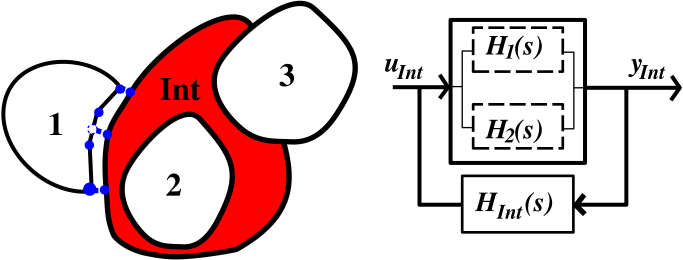
One starts by considering disjoint components coupled by interface component(s) that are physical parts of the structure and can be modeled by the finite element method. Each component corresponds to a dynamic system characterized by its I/O behavior Hi(s). Inputs and outputs of the component models correspond to interface DOFs.
Traditionally, interface DOFs for the interface model match those of the components (the meshes are compatible). In practice the only requirement for a coupled prediction is that the interface DOFs linked to components be linearly related to the component DOFs qj int = [cj] [qj]. The assumption that the components are disjoint assures that this is always possible. The observation matrices cj are Boolean matrices for compatible meshes and involve interpolation otherwise.
Because of the duality between force and displacement (reciprocity assumption), forces applied by the interface(s) on the components are described by an input shape matrix which is the transpose of the output shape matrix describing the motion of interface DOFs linked to components based on component DOFs. Reduced component models must thus be accurate for all those inputs. CMS methods achieve this objective by keeping all the associated constraint or attachment modes.
Considering that the motion of the interface DOFs linked to components is imposed by the components, the coupled system (closed-loop response) is simply obtained adding the dynamic stiffness of the components and interfaces. For a case with two components and an interface with no internal DOFs, this results in a model coupled by the dynamic stiffness of the interface
| (6.109) |
The traditional CMS perspective is to have the dimension of the interface(s) go to zero. This can be seen as a special case of coupling with an interface stiffness
| (6.110) |
where є tends to zero. The limiting case could clearly be rewritten as a problem with a displacement constraint (generalized kinematic or Dirichlet boundary condition)
| (6.111) |
Most CMS methods state the problem this way and spend a lot of energy finding an explicit method to eliminate the constraint. The SDT encourages you to use fe_coor which eliminates the constraint numerically and thus leaves much more freedom on how you reduce the component models.
In particular, this allows a reduction of the number of possible interface deformations [49]. But this reduction should be done with caution to prevent locking (excessive stiffening of the interface).
Methods described up to now, have not taken into account the fact that in (6.93) the dynamic stiffness can depend on some variable parameters. To apply model reduction to a variable model, the simplest approach is to retain the low frequency normal modes of the nominal model. This approach is however often very poor even if many modes are retained. Much better results can be obtained by taking some knowledge about the modifications into account [9].
In many cases, modifications affect a few DOFs: Δ Z = Z(α)−Z(α0) is a matrix with mostly zeros on the diagonal and/or could be written as an outer product Δ ZN× N = [bI] [Δ Ẑ]NB× NB [bI]T with NB much smaller than N. An appropriate reduction basis then combines nominal normal modes and static responses to the loads bI
| (6.112) |
In other cases, you know a typical range of allowed parameter variations. You can combine normal modes are selected representative design points to build a multi-model reduction that is exact at these points
| (6.113) |
If you do not know the parameter ranges but have only a few parameters, you should consider a model combining modeshapes and modeshape sensitivities [50] (as shown in the gartup demo)
| (6.114) |
For a better discussion of the theoretical background of fixed basis reduction for variable models see Refs. [9] and [50].