PDF Index
|
Contents
Functions
PDF Index |
Dynamic loads applied to a discretized mechanical model can be decomposed into a product {F}q= [b] {u(t)} where
Similarly it is assumed that the outputs {y} (displacements but also strains, stresses, etc.) are linearly related to the model coordinates {q} through the sensor output shape matrix ({y} = [c] {q}).
Input and output shape matrices are typically generated with fe_c or fe_load. Understanding what they represent and how they are transformed when model DOFs/states are changed is essential.
Linear mechanical models take the general forms
| (5.1) |
in the frequency domain (with Z(s)=Ms2+Cs+K), and
| (5.2) |
in the time domain.
In the model form (5.1), the first set of equations describes the evolution of {q}. The components of q are called Degrees Of Freedom (DOFs) by mechanical engineers and states in control theory. The second observation equation is rarely considered by mechanical engineers (hopefully the SDT may change this). The purpose of this distinction is to lead to the block diagram representation of the structural dynamics

which is very useful for applications in both control and mechanics.
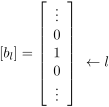
In the simplest case of a point force input at a DOF ql, the input shape matrix is equal to zero except for DOF l where it takes the value 1
| (5.3) |
Since {ql} = [bl]T {q}, the transpose this Boolean input shape matrix is often called a localization matrix. Boolean input/output shape matrices are easily generated by fe_c (see the section on DOF selection ).
Input/output shape matrices become really useful when not Boolean. For applications considered in the SDT they are key to