5.4 State space models
While normal mode models are appropriate for structures, state-space
models allow the representation of more general linear
dynamic systems and are commonly used in the Control Toolbox or Simulink. The standard form for state
space-models is
with inputs {u}, states {x} and outputs {y}.
State-space models are represented in the SDT, as generally done in other Toolboxes for use with MATLAB, using four independent matrix variables a, b, c, and d (you should also take a look at the LTI state-space object of the Control Toolbox).
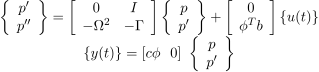
The natural state-space representation of normal mode models
(5.4) is given by
Transformations to this form are provided by nor2ss and fe2ss.
Another special form of state-space models is constructed by res2ss.
A state-space representation of the nominal structural model (5.1) is given by
The interest of this representation is mostly academic because it does not preserve symmetry (an useful feature of models of structures associated to the assumption of reciprocity) and because M−1K is usually a full matrix (so that the associated memory requirements for a realistic finite element model would be prohibitive). The SDT thus always starts by transforming a model to the normal mode form and the associated state-space model (5.13).
The transfer functions from inputs to outputs are described in the
frequency domain by
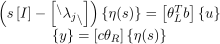
assuming that [A] is diagonalizable in the basis of complex
modes, model (5.12) is equivalent to the diagonal model
where the left and right modeshapes (columns of [θR] and
[θL]) are solution of
and verify the orthogonality conditions
The diagonal state space form corresponds to the partial fraction
expansion
where the contribution of each mode is characterized by the
pole location λj and the residue matrix Rj (which is equal to the product of the complex modal
output {cθj} by the modal input
{θjTb}).
The partial fraction expansion (5.19) is heavily used for the
identification routines implemented in the SDT (see the section on the pole/residue representation ref .
©1991-2019 by SDTools