PDF Index
|
Contents
Functions
PDF Index |
Purpose
Fluid structure/coupling with non-linear follower pressure support.
Description
Elasto-acoustic coupling is used to model structures containing a compressible, non-weighing fluid, with or without a free surface.
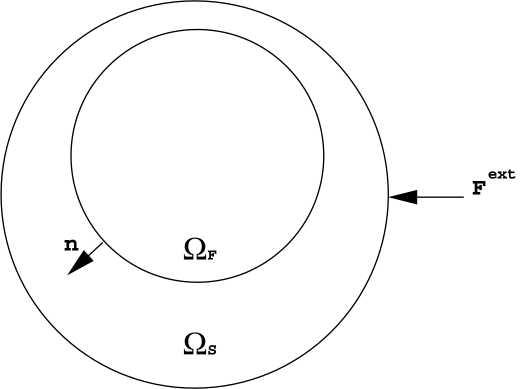
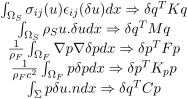
The FE formulation for this type of problem can be written as [44]
| (9.7) |
with q the displacements of the structure, p the pressure variations in the fluid and Fext the external load applied to the structure, where
| (9.8) |
To assemble fluid/structure coupling matrix you should declare a set of surface elements (any topology) with property p_solid('dbval 1 fsc'). The C matrix (solid forces induced by pressure field) is assembled with the stiffness (matrix type 1), while the CT matrix (fluid pressure due to normal velocity of solid) is assembled with the mass (matrix type 2).
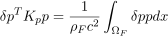
Some formulations, consider a surface impedance proportional to the pressure. This matrix can be computed by defining a group of surface elements with an acoustic material (see m_elastic 2) and a standard surface integration rule (p_solid('dbval 1 d2 -3')). This results in a mass given by
| (9.9) |
Follower force
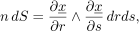
One uses the identity
| (9.10) |
where (r,s) designate local coordinates of the face (assumed such that the normal is outgoing). Work of the pressure is thus:
| (9.11) |
On thus must add the non-linear stiffness term:
| (9.12) |
Using 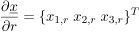 (idem for s), and also
| (9.13) |
this results in
| (9.14) |
Tests : fsc3 testsimple and fsc3 test.
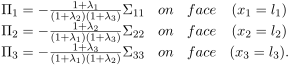
In the RivlinCube test , the pressure on each free face is given by
| (9.15) |
Non-conform
SDT supports non conforming element for fluid/structure coupling terms corresponding to the structure are computed using the classical elements of the SDT, and terms corresponding to the fluid are computed using the fluid elements (see flui4).
The coupling term C is computed using fluid/structure coupling elements (fsc elements).
Only one integration point on each element (the center of gravity) is used to evaluate C.
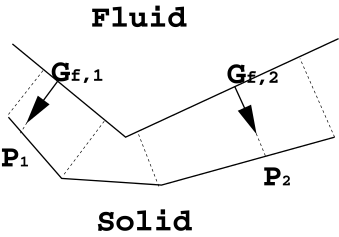
When structural and fluid meshes do not match at boundaries, pairing of elements needs to be done. The pairing procedure can be described for each element. For each fluid element Fi, one takes the center of gravity Gf,i (see figure), and searches the solid element Si which is in front of the center of gravity, in the direction of the normal to the fluid element Fi. The projection of Gf,i on the solid element, Pi, belongs to Si, and one computes the reference coordinate r and s of Pi in Si (if Si is a quad4, −1<r<1 and −1<s<1). Thus one knows the weights that have to be associated to each node of Si. The coupling term will associate the DOFs of Fi to the DOFs of Si, with the corresponding weights.
See also